A luxury boat Komodo cruise costs about USD 1,500 to 2,500 per cabin per night on overnight liveaboards, while private day charters from Labuan Bajo start near USD 500. Price is driven by the vessel, cabin class, trip length and season, with July to September commanding the highest peak-period rates.
- Overnight cabins: USD 1,500 to 2,500 per night
- Private day charters: from USD 500
- Cost drivers: vessel, cabin, length, season
Komodo cruise prices are quoted in US dollars and vary with the boat, the cabin and the season. The sections below break down day-charter versus overnight rates, what is and is not included, and how peak months from July to September affect the final figure. For the wider planning context, read it alongside the complete luxury boat Komodo guide and the fleet comparison.
What Actually Drives the Price
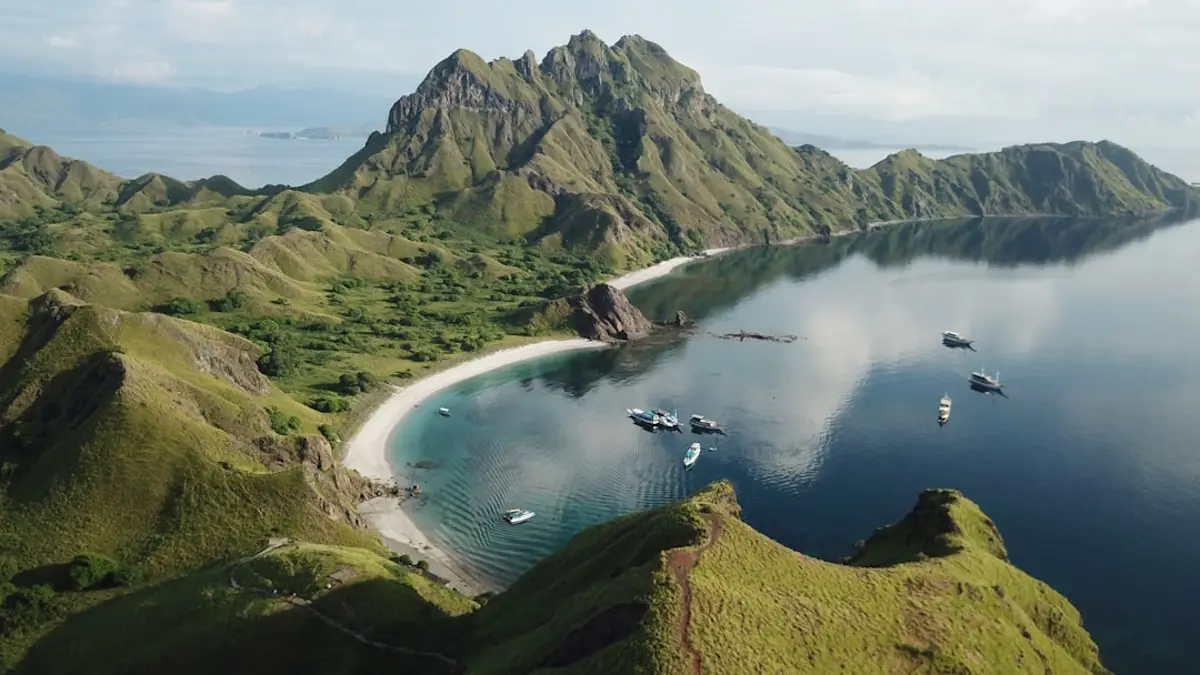
Before looking at headline numbers, it helps to know what you are paying for. Five factors move a Komodo quote more than anything else:
- The vessel itself. A 65-metre flagship phinisi with a near 1:1 crew ratio costs far more per night than a comfortable midrange boat — you are paying for the build, the crew and the service standard.
- Cabin class. A lower-deck twin and a top-deck owner’s suite on the same boat can differ by USD 1,000 or more per night.
- Trip length. Per-night rates often soften slightly on longer charters, but total spend rises with each night.
- Season. The July-to-September peak adds roughly 15 to 20 percent over shoulder-month rates.
- Private charter vs shared cabin. Taking the whole boat buys route control but costs more than booking a single cabin on a scheduled departure.
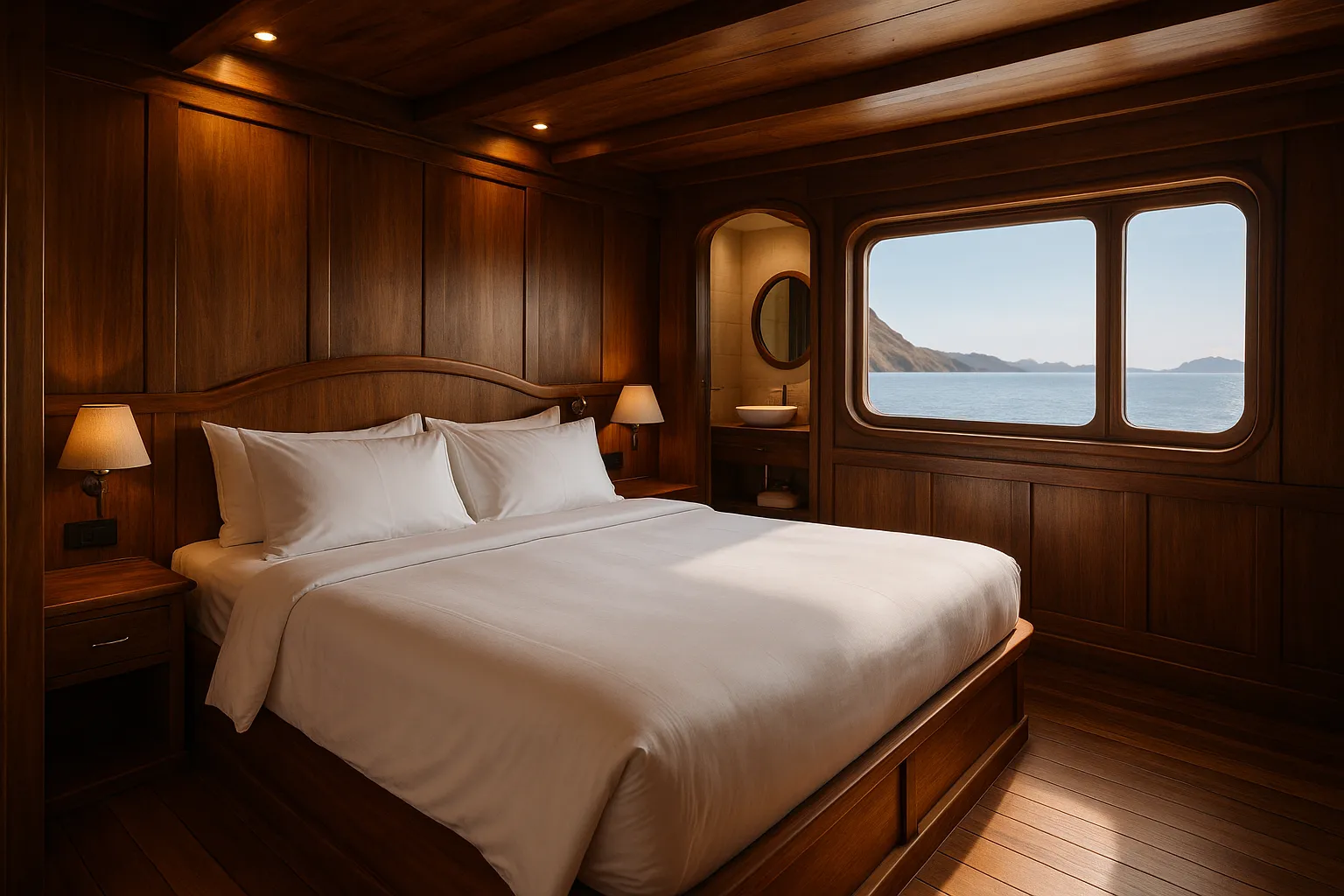
Per-Cabin USD Rates at a Glance
The table below shows realistic dry-season ranges for the per-cabin, per-night rate by class. Peak July-to-September dates sit at the upper end or above.
| Cabin class | Guests | Per cabin / night (USD) | 3-night total (USD) |
|---|---|---|---|
| Standard / lower-deck twin | 2 | 1,500–1,800 | 4,500–5,400 |
| Deluxe / main-deck | 2 | 1,800–2,200 | 5,400–6,600 |
| Master / owner’s suite | 2–3 | 2,200–3,000+ | 6,600–9,000+ |
These figures cover the cabin, all meals, guided dives or snorkelling and crew. Park and ranger fees are usually added on top — see the dedicated section below. To see which named boats fall into each band, the fleet page compares them side by side.
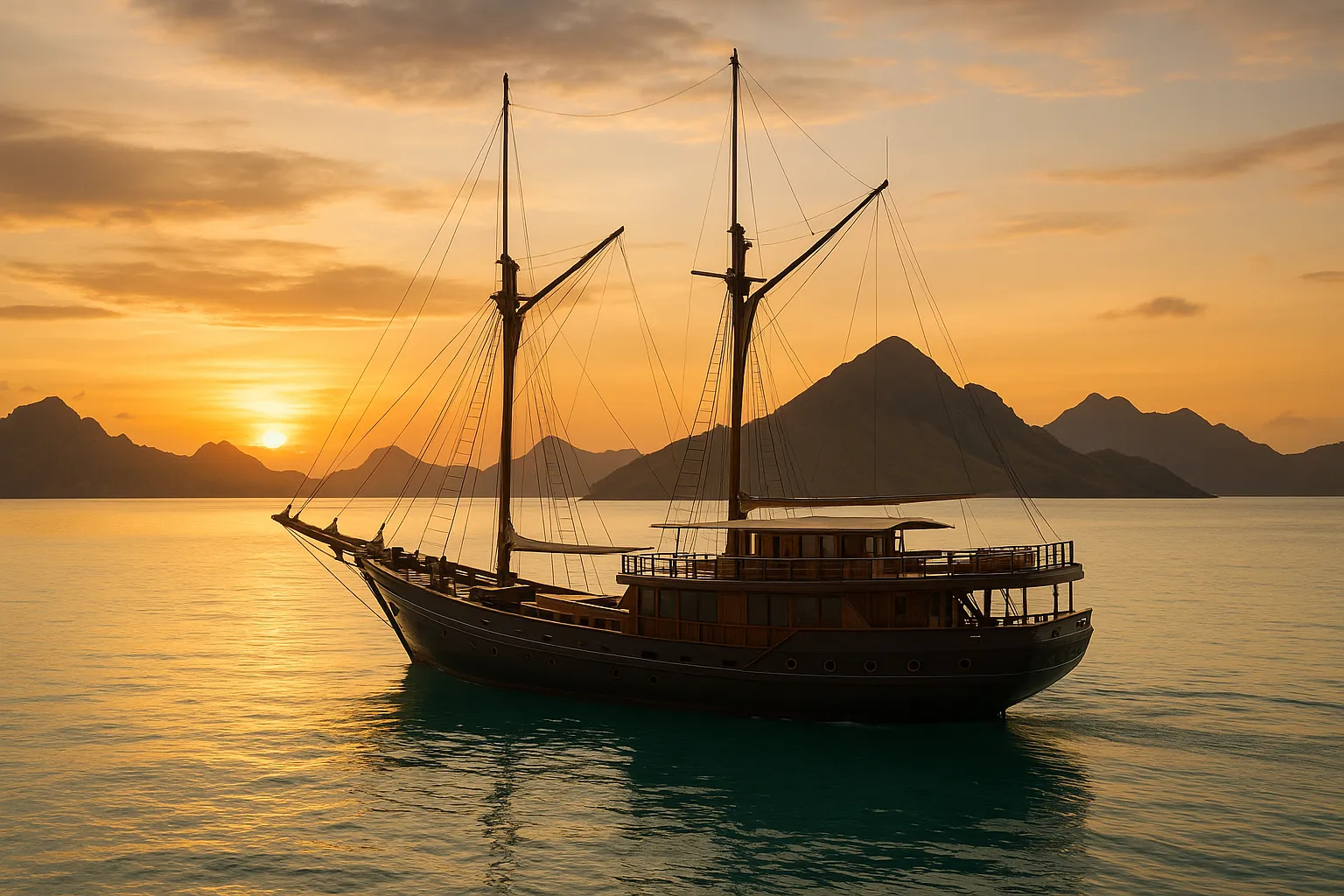
Named Boats and Where They Sit on Price
Travellers comparing cost usually circle the same vessels. As a rough guide:
- Lamima — the largest and most expensive in the fleet, typically chartered whole; expect the top of the range for a full-boat week.
- Alila Purnama and Prana by Atzaro — flagship-tier boats with master suites at the higher per-cabin rates.
- Silolona and Si Datu Bua — premium phinisi, strong value for serious divers who want range.
- Midrange dive liveaboards — sit nearer the USD 1,500 per-cabin floor while still offering ensuite cabins and air conditioning.
Picking the right one is as much about fit as price; our guide explains how the boats differ beyond cost.
Day Trips vs. Liveaboards: Cost and Experience Comparison
Choosing between a day trip and a liveaboard is partly a budget decision. Private day charters from Labuan Bajo start around USD 500 and reach the closest highlights — Padar Island and Pink Beach — in 8 to 10 hours; shared day-boat seats can be far cheaper at USD 150 to USD 300 per person. Overnight liveaboards start near USD 1,000 per person and rise with cabin class, but they reach the dragons, the northern dive sites and the quiet anchorages a day boat never sees. The table sets the two side by side.
| Option | Indicative cost | Reaches | Best for |
|---|---|---|---|
| Shared day tour | USD 150–300 pp | Padar, Pink Beach, 1 snorkel | Tight budgets, short stops |
| Private day charter | From USD 500 (boat) | Padar, Pink Beach, flexible | Families wanting privacy for a day |
| Overnight liveaboard | USD 1,500–2,500 / cabin / night | Dragons, Manta Point, northern sites | Divers, honeymoons, photographers |
If you are weighing length against budget, send us your dates and party size and we will price both for that exact window.
What Is Included — and What Is Not
A clear quote should itemise inclusions. On a well-run charter the per-cabin rate typically covers the cabin, all meals and soft drinks, guided dives or snorkelling with tanks and weights, and often the airport transfer. What is commonly charged separately:
- Park entry and ranger fees — roughly USD 10 to USD 15 per person per day for international visitors, paid to the national park.
- Nitrox — sometimes included on dive-led boats, sometimes a daily supplement.
- Equipment rental — if you do not bring your own, budget around USD 30 per day for a full dive kit.
- Alcohol — wine and spirits are often a separate bar tab.
- Crew gratuities — customary at the end of the trip and not built into the fare.
Getting these in writing before you pay is the single best way to avoid a surprise at the dock. We itemise them in every quote we prepare.
Park Fees and Government Charges
Komodo National Park charges entry and activity fees that are set by the Indonesian authorities and collected on arrival or built into your package. For international visitors these run in the region of USD 10 to USD 15 per person per day once entry, ranger and conservation components are combined, with small extra charges for diving and for the ranger-led dragon walk on Komodo or Rinca. Fees change periodically, so a reputable operator quotes the current figure and confirms whether it is included or added. These charges fund conservation and the ranger service, and paying them through a licensed operator keeps your trip on the right side of park rules.
How Season Changes the Number
The same cabin can cost noticeably more in August than in May. The dry season from April to November is when nearly everyone wants to sail, and the July-to-September peak — calmest seas, best visibility, peak manta activity — carries a premium of roughly 15 to 20 percent. The shoulder windows of April to June and October to November offer the same boats and very similar diving for less, and they are quieter. December to March, the wet season, sees the lowest demand and the lowest rates, though crossings can be rougher and some sites may be swapped for sheltered alternatives.
| Window | Relative price | Notes |
|---|---|---|
| April–June | Shoulder | Good value, clearing visibility |
| July–September | Peak (+15–20%) | Best conditions, books out early |
| October–November | Shoulder | Quiet, warm water, fewer boats |
| December–March | Lowest | Wet season, flexible deals |
Sample Total Budgets
To make the numbers concrete, here are three realistic all-in estimates for two people, excluding international flights but including the regional Bali–Labuan Bajo hop and park fees.
- Value 3-night cruise, shoulder season, standard cabin: roughly USD 5,400 cabin + USD 300 flights + USD 90 park fees = around USD 5,800.
- Premium 4-night cruise, peak season, deluxe cabin: roughly USD 8,800 cabin + USD 400 flights + USD 120 park fees = around USD 9,300.
- Flagship 5-night charter, master suite: from around USD 15,000 cabin upward, plus flights and fees, before any whole-boat charter premium.
These are planning ballparks, not quotes; the exact figure depends on the boat and dates. For a firm number, share your travel window and we return a tailored quote within 24 hours.
Getting to Labuan Bajo: The Cost Before the Boat
Most cruises start in Labuan Bajo, so budget for the journey there. Round-trip flights from Bali run roughly USD 100 to USD 300 depending on season and how far ahead you book, with the cheapest fares well in advance. A night in Labuan Bajo before embarkation is wise for early departures; design hotels on the ridge run around USD 150 a night, with simpler options for less. The airport-to-harbour transfer is short and usually included in a luxury fare. Factoring these in keeps your total realistic rather than just the cabin rate.
Ways to Manage the Cost Without Cutting Quality
There are sensible ways to bring the number down that do not mean a worse trip. Travelling in the shoulder months saves 15 to 20 percent for nearly identical diving. Booking a lower-deck cabin on a flagship boat gives you the same crew, food and itinerary as a suite guest for less. Filling a whole boat with friends or family spreads the charter premium across more cabins and buys you full route control. And booking early locks in the better cabins before peak-season scarcity pushes rates up. We are happy to model these options against your dates — that is the point of an independent quote.
Is It Worth It?
A luxury boat is the most expensive way to see Komodo, and for many travellers it is also the only way to see it properly. You reach the dragons, the manta cleaning stations and the northern reefs that day boats cannot, you wake up already on site for the best light, and you unpack once. If your trip is built around diving, photography or a honeymoon, the cruise is usually what made the journey worthwhile. If time or budget is tight, a land base with day tours is a fair alternative — our main guide compares the two.
Step-by-Step: Pricing Your Komodo Cruise
- Choose your length and cabin class against the per-cabin table above.
- Apply the season factor — add 15 to 20 percent for July to September.
- Add park and ranger fees at roughly USD 10 to 15 per person per day.
- Add the regional flights and a pre-cruise hotel night in Labuan Bajo.
- Confirm inclusions in writing so nitrox, gear and gratuities are not a surprise.
- Request a tailored quote to replace the estimate with a firm figure for your dates.
Cost Per Person by Group Size
On a private charter the per-person cost falls as you fill more cabins, because the fixed boat and crew cost is shared. This is why a couple often pays a noticeably higher per-head rate than a group taking the whole boat. The example below uses a mid-tier boat at roughly USD 1,900 per cabin per night for three nights.
| Party | Cabins | Approx. total (3 nights) | Per person |
|---|---|---|---|
| Couple | 1 | ~USD 5,700 | ~USD 2,850 |
| Two couples | 2 | ~USD 11,400 | ~USD 2,850 |
| Family of four (2 cabins) | 2 | ~USD 11,400 | ~USD 2,850 |
| Group of eight (4 cabins, whole small boat) | 4 | ~USD 22,800 | ~USD 2,850 |
Per-cabin pricing keeps the per-person figure steady, but a full-boat charter gives you route control and, on some boats, a charter discount that shared bookings do not get. If you can fill the cabins, ask whether a whole-boat rate beats booking them individually.
How Komodo Compares to Other Indonesian Cruises
Travellers often price Komodo against Raja Ampat and a Bali-based trip. Komodo is the most accessible of the three: short flights from Bali, shorter crossings inside the park, and a dense set of sites close together, which keeps total cost down for the experience you get. Raja Ampat offers arguably richer reefs but sits much further east, so flights, transfers and longer charters push the total higher. A Bali land holiday with the occasional boat day is the cheapest but is a different trip entirely — you are not cruising a marine park. For a first liveaboard in Indonesia, Komodo usually gives the best ratio of reward to spend.
Deposits, Payment and Cancellation
Most luxury operators ask for a deposit of around 25 to 50 percent to confirm a cabin, with the balance due several weeks before departure. Payment is normally by bank transfer in USD; some boats accept cards with a surcharge. Cancellation terms tighten as the date approaches, so read them before you pay: a fair operator publishes a clear schedule and explains how weather-related route changes or a missed site are handled. Travel insurance that covers trip cancellation and diving is strongly recommended, particularly in the wet season when crossings are more variable. We confirm the exact deposit and cancellation terms of any boat we quote so there are no surprises later.
Extras Worth Budgeting For
Beyond the headline fare and park fees, a handful of smaller costs add up. Crew gratuities at the end of the trip are customary and not in the fare. A satellite or onboard Wi-Fi package, where offered, may be charged. Drone use, video packages and professional underwater photography are sometimes available as add-ons. If you plan to dive nitrox throughout, confirm whether it is a flat supplement or per-tank. None of these is large on its own, but together they can add a few hundred dollars to a longer trip, so factor them into your planning figure rather than discovering them on board.
Booking Early vs Last Minute
The pricing logic in Komodo rewards early booking for peak dates and can reward flexibility off-peak. For July to September, the best cabins on the popular boats sell out weeks ahead and prices firm up as space disappears, so booking early both secures the cabin you want and avoids late-season premiums. In the shoulder and wet months there is more give, and operators sometimes release short-notice space at softer rates to fill a departure. If your dates are fixed in high season, book early; if you are flexible and travelling off-peak, it can pay to ask what is available close in.
Single, Double and Triple Occupancy
How you fill a cabin changes the maths. Rates are usually quoted per cabin on a twin or double-occupancy basis, so two people sharing pay the listed cabin rate between them. Solo travellers who want a cabin to themselves often face a single supplement — sometimes the full cabin rate, sometimes a reduced premium — or can join a shared departure and pair with another guest. Families adding a child on a third bed in a master suite typically pay a modest extra rather than a second full fare. If you are travelling solo or with an odd number, ask specifically how the operator handles occupancy before comparing quotes, because a “per person” figure and a “per cabin” figure are not the same thing.
| Occupancy | How it is priced | Typical impact |
|---|---|---|
| Double (2 sharing) | Cabin rate split two ways | Best per-person value |
| Single (sole use) | Cabin rate + single supplement | 50–100% premium over half-cabin |
| Triple (extra bed) | Cabin rate + child/third-guest add | Small extra, suite-dependent |
Why Cheap Komodo Boats Cost More in the End
It is tempting to chase the lowest advertised rate, but the budget end of the Komodo market is where most traveller complaints come from. The savings usually hide in places you only discover on board: an older boat with weaker air conditioning, a thinner crew so guides are stretched across too many divers, snorkel-grade rather than dive-grade gear, fewer sites because the boat is slower, and inclusions that turn out to be extras. A genuine luxury fare buys margin — spare equipment, a back-up plan when a site is blown out, and crew who can adapt the route. Spending a little more on a properly certified, well-crewed boat is what protects the holiday you flew across the world for. This is why we vet operators before recommending them rather than simply forwarding the cheapest quote.
Where the Money Goes on a Luxury Charter
It helps to understand why a luxury Komodo boat costs what it does, because it makes the price feel less like a mystery and more like a set of choices. A large share of the fare pays the crew — captain, engineers, dive guides, chef, stewards — who on the best boats outnumber the guests. Fuel for a heavy wooden vessel covering 100-plus nautical miles is significant. Food is genuinely fresh and chef-prepared, not a buffet, and provisioning a remote multi-day trip is costly. Maintenance on a classic phinisi, the dive compressors, tenders and safety equipment all carry ongoing expense, as does the insurance a properly run operation must hold. When you compare two quotes, you are really comparing how much of this each operator is willing to fund — which is exactly why the cheapest boat and the safest, most comfortable boat are rarely the same one.
Currency, Payment and On-the-Ground Cash
Komodo cruises are quoted and usually paid in US dollars, which keeps pricing stable for international guests regardless of the local exchange rate. On the ground in Labuan Bajo the currency is the Indonesian rupiah; cards are accepted at hotels and larger restaurants, but it is worth carrying some cash for markets, small cafes, tips and incidental purchases before and after the cruise. ATMs in town dispense rupiah. Because the cruise itself is prepaid, your in-trip spending is mostly gratuities, the bar tab and any add-ons, so you rarely need large amounts of cash aboard.
Tipping and Crew Gratuities
Gratuities are customary on Komodo charters and are not built into the fare, so set aside a little for the crew at the end of the trip. There is no fixed rule, but many guests budget a modest daily amount per person, pooled and handed to the captain to share among the crew — the dive guides, chef, engineers and stewards who make the voyage work. On a well-run boat the service genuinely earns it, and a fair tip is a small fraction of the overall cost. Ask the operator if they have a suggested guideline; most are happy to advise so you are not left guessing on the last morning.
Putting a Realistic Number on Your Trip
The honest answer to “what does a luxury boat Komodo cruise cost?” is that a couple should plan for somewhere between USD 5,500 and USD 10,000 all-in for a three to four-night dry-season cruise, depending on the boat and cabin, before international flights. Larger groups filling a whole boat hold the per-person figure steady while gaining route control. Flagship suites and week-long charters run well above that. The single most useful step you can take is to replace this estimate with a firm quote for your exact dates and party, which removes the guesswork on season, cabin availability and inclusions.
When you are ready, compare the boats on the fleet page, match an itinerary on the packages page, then send your dates for a luxury boat Komodo quote. For background on the park, see UNESCO and the Indonesia travel portal.