This luxury boat Komodo guide covers everything you need to plan a private Komodo National Park cruise from Labuan Bajo: vessel and cabin types, day-trip versus overnight choices, the Padar to Manta Point route, USD 1,500 to 2,500 per-cabin overnight rates, and why April to November offers the calmest seas.
- Phinisi schooners and motor yachts compared
- Master, deluxe and standard cabin classes
- Routes covering Padar, Pink Beach, Komodo and Batu Bolong
Komodo National Park is a UNESCO World Heritage Site of more than 1,500 reef-fish species and around 75 percent of the world’s known coral species. A luxury cruise is the practical way to reach its scattered islands and dive sites in a few unhurried days. Use this guide alongside our per-cabin USD cost breakdown and the fleet comparison of phinisi versus motor yachts when you are ready to shortlist a boat.
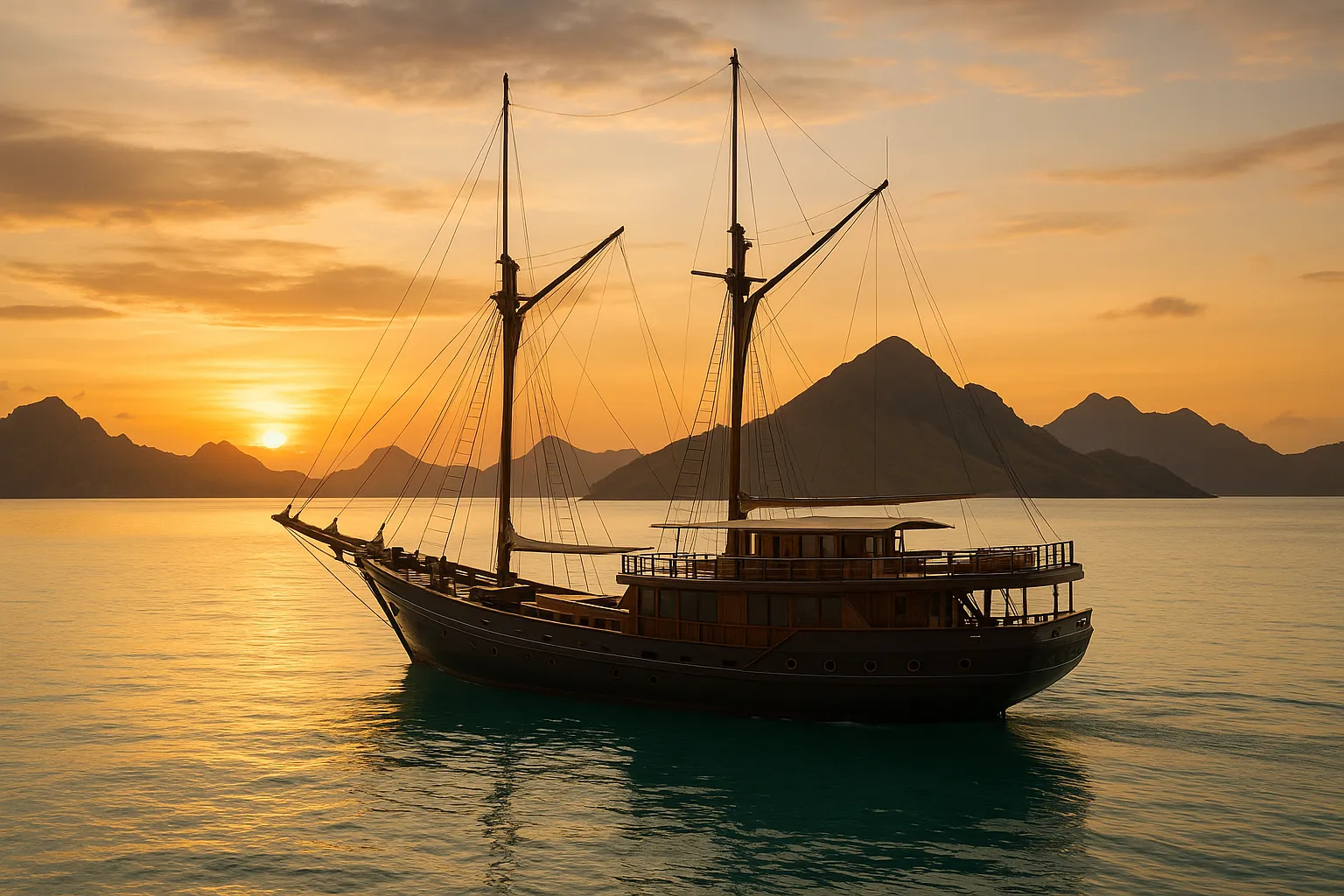
The Essence of Luxury Boat Komodo
Luxury boats in Komodo National Park let you reach the park’s scattered islands without backtracking to a hotel each night. These vessels are usually over 30 metres long, with premium cabins, plush bedding and ensuite bathrooms. Reputable operators carry RINA or Lloyd’s Register classification, which sets the safety and build standards you should ask about before you book. Routes typically include dive stops such as Batu Bolong and Manta Point, with itineraries running from a single day to a week. Day charters start near USD 500, while overnight cabins run USD 1,500 to 2,500 per night depending on the cabin class and season — you can see exactly how those rates are structured in our cost guide. Many operators also follow practical conservation measures, such as mooring buoys instead of anchoring on coral.
Named Boats and What Sets Them Apart
Most travellers comparing a luxury boat Komodo cruise will run into the same handful of well-known vessels. Knowing how they differ shortens the search.
- Lamima — a 65-metre phinisi, one of the largest wooden sailing yachts in the world, with seven cabins for up to 14 guests and a near 1:1 crew ratio. Best for families or groups who want a full-charter feel.
- Alila Purnama — a 46-metre three-masted phinisi with five cabins, including a top-deck owner’s suite with panoramic windows. Strong choice for couples wanting hotel-grade service.
- Silolona and Si Datu Bua — classic ironwood phinisi built for long Coral Triangle passages, suited to keen divers who want range and stability.
- Aliikai and Prana by Atzaro — larger 50-to-55-metre yachts with more deck space, spa areas and room for nine cabins.
If you are weighing one against another, our fleet page compares cabins, length and guest capacity side by side, and the packages page maps 2 to 5-day itineraries onto each boat type.
Day Trips vs. Overnight Cruises
Choosing between a day trip and an overnight cruise in Komodo depends on how much of the park you want to reach. Day trips, typically lasting 8 to 10 hours, cover the closest highlights — usually Padar Island, Pink Beach and one snorkel site — for around USD 150 to USD 300 per person on a shared boat, or from USD 500 for a private day charter. Overnight cruises of two to seven nights reach the dragons on Komodo and Rinca plus the better dive sites, and start around USD 1,000 per person, rising with cabin class. If your trip hinges on diving Manta Point or Batu Bolong, an overnight is the only reliable way to be on site at slack tide.
Quick comparison
| Factor | Day trip | Overnight cruise (2–5 nights) |
|---|---|---|
| Typical price | USD 150–300 pp shared / from USD 500 private | From USD 1,000 pp; USD 1,500–2,500 per cabin/night on premium boats |
| Sites reached | Padar, Pink Beach, 1 snorkel stop | Padar, Pink Beach, Komodo, Rinca, Batu Bolong, Manta Point, Kanawa |
| Komodo dragons | Rarely (time-limited) | Yes — Komodo or Rinca ranger walk |
| Diving | Snorkel only | 2–4 dives/day at slack tide |
| Best for | Short Labuan Bajo stopovers | Divers, photographers, honeymoons |
Still unsure which length suits your dates? Send us your travel window and we will recommend day versus overnight for that exact period.
Understanding Routes and Itineraries
Routes for luxury boats in Komodo are planned to balance travel time with time in the water. Departing from Labuan Bajo, a standard loop takes in Komodo Island, Rinca Island and Padar Island, with most legs under 20 nautical miles so you are rarely under way for more than a couple of hours. The best diving season, from April to November, lines up with calm seas and clear visibility. Most itineraries can be tailored toward diving, hiking or photography — tell the operator your priority and the captain reorders the stops around tide and light.
A typical 4-day, 3-night route, day by day
- Day 1 — Labuan Bajo to Sebayur: board by mid-afternoon, check dive gear, a warm-up dive or snorkel at Sebayur, sunset at anchor.
- Day 2 — Batu Bolong, Tatawa and Pink Beach: the signature pinnacle dive at Batu Bolong at slack tide, a drift at Tatawa Besar, then the pink coral sand of Pink Beach in the afternoon.
- Day 3 — Manta Point, Komodo Island ranger walk, Padar sunset: early manta encounter at Manta Point, a guided dragon walk on Komodo or Rinca, then the climb to the Padar Island viewpoint for sunset.
- Day 4 — Kanawa or Kelor, return to Labuan Bajo: a final swim and snorkel close to port, disembark before lunch.
This is the route most premium boats sail; longer 5 to 7-night charters add the southern sites and the quieter northern reefs. Our destinations page maps each of these stops if you want to picture the geography first.
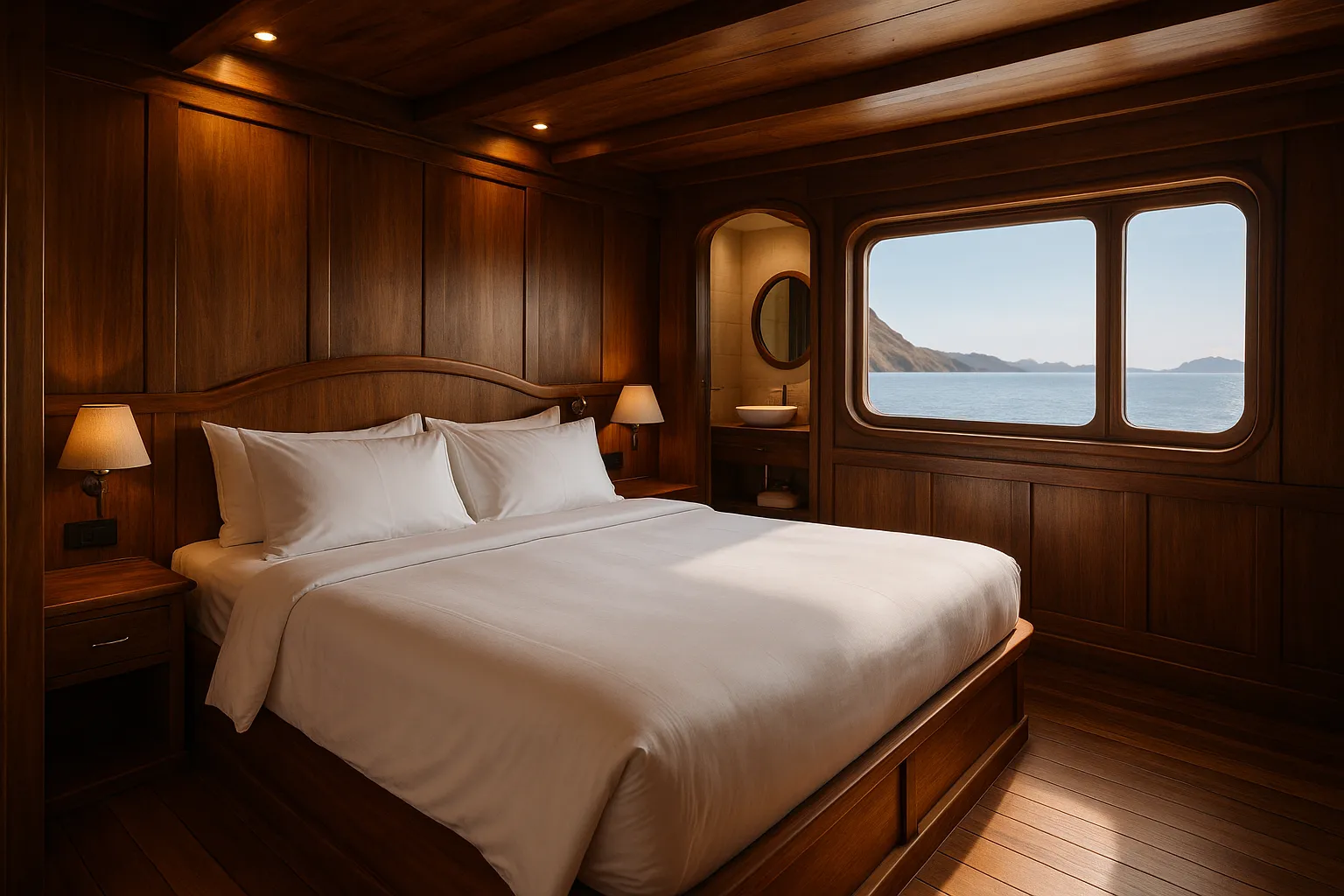
Cabin Options and Amenities
Luxury boats in Komodo offer several cabin classes, and the class you pick is the single biggest factor in your nightly rate. Cabins typically feature king or twin beds, air conditioning, ensuite bathrooms and, on the better boats, panoramic windows. Onboard you can expect chef-prepared dining, shaded sun decks and, on dive-focused vessels, a dedicated dive deck with nitrox. Crew-to-guest ratios on the top boats approach 1:1, which is what separates a genuine luxury charter from a comfortable midrange one.
Indicative per-cabin USD rates
| Cabin class | Typical guests | Per cabin, per night (USD) |
|---|---|---|
| Standard / lower-deck twin | 2 | 1,500–1,800 |
| Deluxe / main-deck | 2 | 1,800–2,200 |
| Master / owner’s suite | 2–3 | 2,200–3,000+ |
Rates above assume the dry-season window; expect a step up of roughly 15 to 20 percent across the July to September peak. For the full breakdown including park fees and what is and is not included, read our Komodo luxury boat cost guide.
Regulations and Certifications
Operating a luxury boat in Komodo means meeting maritime and park rules. Ask any operator for two things in writing: the vessel’s class certificate (RINA, Lloyd’s or equivalent under the International Maritime Organization framework) and confirmation that park entry and ranger fees are included in your quote. Environmental rules inside the park are enforced, and the better operators use mooring buoys, brief guests on no-touch diving and work with Labuan Bajo crews. Choosing an operator that can show this paperwork is the simplest way to avoid the cut-price boats that cause most of the problems travellers report.
Diving Into Komodo’s Marine Sites
Komodo National Park holds some of the most celebrated dive sites in the Coral Triangle. The following are the sites a luxury itinerary is built around, with the depths and conditions to expect.
- Batu Bolong — a pinnacle dive, roughly 5 to 25 m, with dense soft coral; dived only at slack tide because of current.
- Manta Point (Karang Makassar) — a shallow 5 to 12 m cleaning station where manta rays gather, best on an incoming tide.
- Castle Rock and Crystal Rock — northern submerged pinnacles, 4 to 30 m, known for reef sharks and trevally schools in current.
- Tatawa Besar and Tatawa Kecil — gentle to moderate drifts over hard coral, good for 8 to 20 m photography.
- Cape Kri — while best known in nearby Raja Ampat, longer charters that range north chase its record fish counts, 5 to 30 m.
Currents here are real, so Advanced Open Water and some drift experience make the northern sites far more enjoyable. If diving is your reason for the trip, say so when you request a quote and we will match you to a dive-led boat and crew.
Comparing Boat Sizes and Amenities
Luxury boats in Komodo range from intimate yachts to larger liveaboards, each with a different feel. Smaller boats, up to about 12 guests, give you privacy, larger common areas per head and crew who learn your name by day two. Larger vessels host up to 30 guests and add facilities such as a spa cabin, larger dive decks and shaded lounges. Couples and honeymooners usually prefer the smaller boats; dive clubs and multi-family groups often take a larger one for the deck space. Our fleet comparison lays out guest capacity and cabin counts so you can match the boat to your group size.
Step-by-Step: Booking Your Luxury Boat Komodo Experience
- Define your priority — diving, relaxation or wildlife — because it changes which boat suits you.
- Pick your length using the day-versus-overnight table above; most first-timers choose a 3-night cruise.
- Set a per-cabin budget against the USD table, then confirm what park and ranger fees are included.
- Check the itinerary covers your must-see sites — Padar, Manta Point and a dragon walk for most travellers.
- Book in advance, especially for July to September, when the best cabins sell out weeks ahead.
- Verify certification and conservation practice before you pay a deposit.
When you have your dates, share them with us for a tailored phinisi or yacht quote within 24 hours.
Choosing the Right Season
The timing of your visit shapes the whole trip. The dry season from April to November brings warm, settled weather and calm seas, with underwater visibility often reaching 30 metres. December to March is the wet season: rougher crossings and more rain, but fewer boats and lower rates. The table below summarises the trade-offs.
| Window | Seas & visibility | Crowds & price | Best for |
|---|---|---|---|
| April–June | Calm, clearing visibility | Moderate, shoulder rates | Value with good diving |
| July–September | Calmest, peak visibility, mantas | Busiest, peak rates (+15–20%) | Diving and photography |
| October–November | Still calm, warm water | Quieter, shoulder rates | Honeymoons, fewer boats |
| December–March | Rougher, variable visibility | Lowest demand and price | Budget, flexible travellers |
How to Vet a Komodo Operator Before You Pay
The gap between the best and worst Komodo boats is wide, and most complaints trace back to a handful of avoidable mistakes at the booking stage. Run through this checklist before any deposit leaves your account.
- Ask for the class certificate. A genuine luxury vessel carries RINA, Lloyd’s or an equivalent classification. If an operator cannot produce it, treat that as a red flag.
- Confirm crew and safety ratios. The better boats run close to one crew member per guest and carry a dedicated dive guide for every four divers. Ask how many guests share each guide.
- Get the inclusions in writing. Park entry, ranger fees, dive tanks, weights and nitrox should be itemised. Vague “all-inclusive” wording usually hides extras.
- Check the cancellation and weather policy. December to March crossings can be rerouted; a fair operator tells you in advance how a cancelled site or shortened route is handled.
- Verify the actual boat. Some brokers advertise one vessel and substitute another. Ask for the boat name and recent photos, then cross-check it on the fleet comparison.
Because we plan trips independently and check operators before recommending them, you can put your shortlist to us and we will flag anything that does not add up before you commit.
Getting There: Flights and Airport Transfers
Almost every Komodo cruise begins in Labuan Bajo, the gateway town on the western tip of Flores. Direct flights run daily from Bali (Denpasar), roughly 1 hour 20 minutes, and from Jakarta via Bali, with seasonal connections from Surabaya. Round-trip fares typically sit between USD 100 and USD 300 depending on how far ahead you book and the season. From Komodo Airport (LBJ) the harbour is a 10 to 20-minute drive, and most luxury boats include the transfer in your fare — confirm this when you book. If you arrive the night before, Labuan Bajo has a growing cluster of design hotels on the ridge above the bay, useful for an early-morning embarkation.
What to Pack for a Komodo Cruise
Space in cabins is limited, so pack soft bags rather than hard cases. The essentials most guests forget are reef-safe sunscreen (regular sunscreen is discouraged inside the park), a rash guard for long snorkel sessions, motion-sickness tablets for the few open crossings, and sturdy trainers or trail sandals for the Padar and dragon-walk climbs. Divers should bring their own mask and computer; most boats supply tanks, weights and rental BCDs but the fit of personal gear matters on multi-dive days. A light layer is worth carrying for breezy evenings on deck and the air-conditioned cabins.
Marine Life and Wildlife Through the Year
Komodo’s headline wildlife is reliable across the dry season, but a few encounters are seasonal. Manta rays gather at Manta Point and Karang Makassar across most of the year, peaking from July to September when plankton blooms draw the largest aggregations. Reef sharks and schooling fish at Castle Rock and Crystal Rock are a year-round draw on the northern sites. Komodo dragons are visible on Komodo and Rinca throughout the year on ranger-led walks, with the cooler early mornings the best time to see them active. Whale and dolphin sightings on the longer crossings are occasional rather than guaranteed. If a specific encounter is the point of your trip, tell us and we will time the itinerary around it.
Honeymoons, Families and Private Charters
Different travellers get the most from different boats. Honeymooners tend to do best on a small five-cabin phinisi where a top-deck owner’s suite and a quieter guest list set the tone. Families travel well on a full private charter, where the crew can pace the day around children and the dive deck doubles as a snorkelling base. Dive clubs and groups of friends often take a larger liveaboard for the deck space and the social dining. Whatever the group, a private full-boat charter buys you control of the route — you decide whether to chase an extra dive or linger at Pink Beach — and on a small boat the per-cabin premium over a shared departure is smaller than most people expect. Our packages page shows which itineraries suit each group type.
Komodo by Boat vs Land-Based Alternatives
It is fair to ask whether you need a boat at all. A land base in Labuan Bajo with day tours works for travellers short on time or prone to seasickness, and it is cheaper per night. But day tours can only reach the closest sites, you repeat the same crossing each morning, and you miss the early and late light that makes Padar and Manta Point special. A cruise reaches the dragons, the northern dive sites and the quiet anchorages a day boat never sees, and you unpack once. For most travellers spending three days or more in the region, the boat is what they came for. If you are still comparing, our cost guide sets the two options side by side on price.
Diving Currents and Certification: What You Need
Komodo is current-driven diving, and that is exactly why the marine life is so dense — moving water feeds the soft coral and pulls in the pelagics. The trade-off is that the best sites are dived on a schedule set by the tide, not the clock. Batu Bolong and the northern pinnacles are slack-tide dives; a good captain reads the tide tables for your dates and the dive guides brief negative-entry descents and reef hooks where needed. For the sheltered sites such as Tatawa and the Manta Point cleaning station, Open Water certification with a few logged dives is enough. For Castle Rock, Crystal Rock and Shotgun, you want Advanced Open Water and genuine comfort in current; many boats ask for a recent logbook or a check dive on day one. If you are newly certified, say so when you book — the crew will steer you to the gentler sites and still show you mantas. Snorkellers are well looked after too: Manta Point, Pink Beach and the shallow reefs around Kanawa are all rewarding without a tank.
Common Questions, Answered Plainly
How many days do I need? Three nights is the sweet spot for a first cruise: enough to reach the dragons, dive or snorkel Manta Point and Batu Bolong, and climb Padar for sunset, without long open crossings. Add nights if diving is the priority or you want the quieter northern sites.
Is it suitable for non-divers? Yes. The snorkelling at Manta Point and Pink Beach, the island walks and the Padar climb fill the days for non-divers, and most boats run a snorkel guide alongside the dive groups.
Will I get seasick? Inside the park the legs are short and the water is usually calm in the dry season, so seasickness is uncommon from April to November. The few open crossings are easier with tablets taken before you sail.
How far ahead should I book? For July to September, six to eight weeks is sensible for the better cabins; the largest suites on the most popular boats go earlier. Shoulder months are more flexible, and the wet season can often be booked close in.
What does a quote actually include? On a well-run charter, the per-cabin rate covers the cabin, all meals, dives or snorkelling, guides, and usually the airport transfer; park and ranger fees may be added separately. Our cost guide itemises exactly what to expect so there are no surprises at the dock.
From there it is a short step to a confirmed cabin: compare boats on the fleet page, match an itinerary on the packages page, then send your dates for a quote. For background, Indonesia’s official tourism portal and the UNESCO listing for Komodo National Park are reliable references.